
Choosing the right variable transformer manufacturer matters for industrial buyers who need reliable, adjustable AC voltage for testing, equipment commissioning, and production applications. A suitable variable transformer provides flexible voltage adjustment, stable operation, and the capacity the connected load requires.
For distributors, engineering contractors, and industrial equipment manufacturers, understanding transformer types, technical specifications, and manufacturing quality can help reduce purchasing risks.
This guide explains what to consider when selecting a variable transformer supplier and how to choose the right solution for your application.
1. What Is a Variable Transformer and How Does It Work?
A variable transformer is an electrical device that allows users to adjust AC output voltage continuously within a specified operating range. It is commonly used in electrical laboratories, industrial testing facilities, motor testing, equipment commissioning, and manufacturing processes.
Many conventional variable transformers use an autotransformer structure. A movable carbon brush contacts the winding, changing the effective number of turns and adjusting the output voltage.
Unlike a conventional fixed-ratio transformer, a variable transformer lets operators select different output voltages to meet testing or operating requirements.
However, buyers should understand one important distinction: a variable transformer is not necessarily an automatic voltage stabilizer. It adjusts voltage according to its control mechanism; it does not automatically compensate for every fluctuation in the input supply.
2. Main Types of Variable Transformers for Industrial Applications
A professional variable transformer manufacturer should offer different configurations to meet various load requirements.
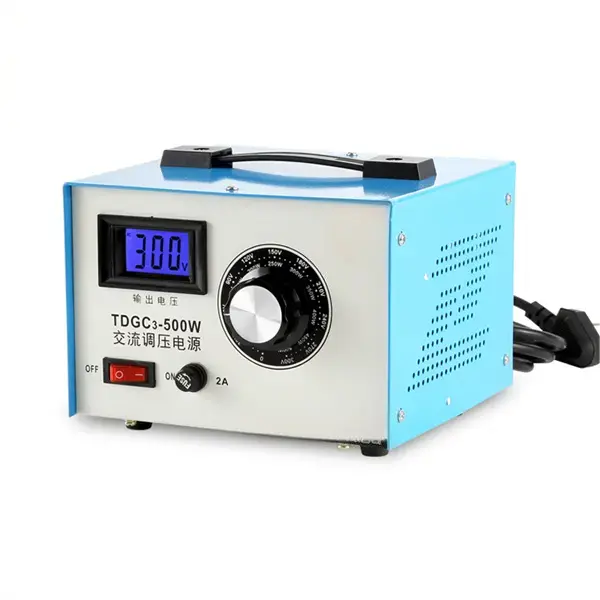
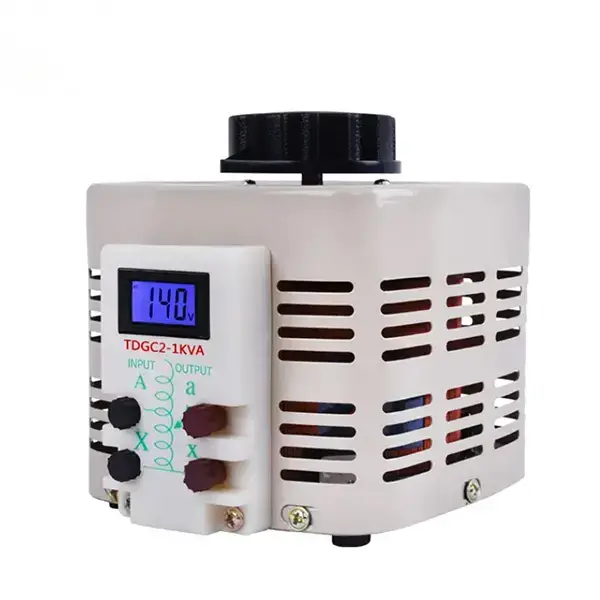
Single-Phase Variable Transformer
Single-phase variable transformers are commonly used in laboratories, electronic equipment testing, small industrial machines, and electrical maintenance.
Typical applications include:
- AC voltage testing for electrical components.
- Testing household and commercial appliances.
- Laboratory power adjustment.
- Equipment commissioning and maintenance.
Three-Phase Variable Transformer
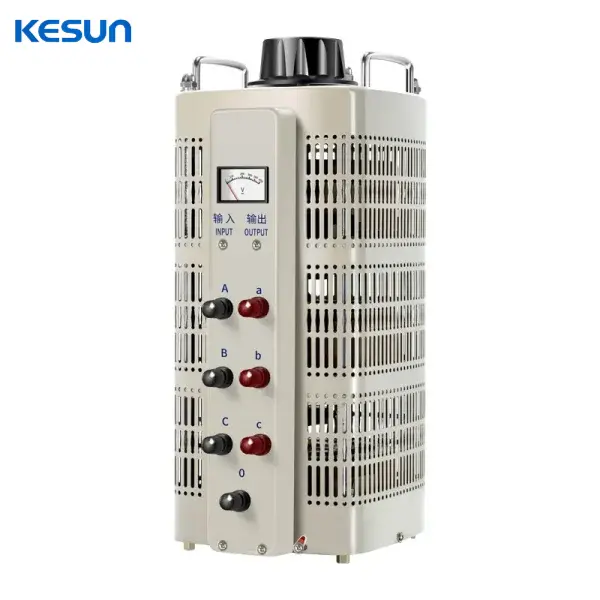
Three-phase variable transformers are designed for industrial equipment and balanced three-phase loads.
They are commonly used for:
- Three-phase motor testing.
- Industrial machinery commissioning.
- Electrical equipment performance testing.
- Production line testing and quality inspection.
For larger industrial applications, buyers should confirm the rated capacity, phase configuration, output voltage range, and current requirements before selecting a model.
Manual and Motor-Driven Variable Transformers
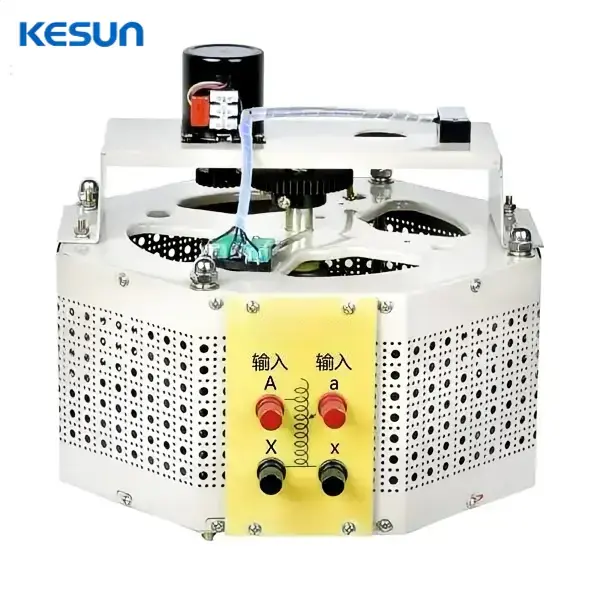
Manual models use a hand-operated control mechanism and suit applications where operators adjust voltage directly.
Motor-driven models use an electric motor to control the adjustment mechanism. They suit automated test benches, remote operation, and applications that require frequent voltage adjustments.
3. Important Specifications When Choosing a Variable Transformer Manufacturer
Comparing variable transformer manufacturers requires more than checking the rated capacity or purchase price.
The following specifications should be reviewed before placing an order.
| Technical parameter | What buyers should check |
|---|---|
| Rated capacity | kVA according to the actual load |
| المرحلة | Single-phase or three-phase |
| Input voltage | Actual site supply voltage |
| Output voltage | Required adjustable voltage range |
| Frequency | 50Hz, 60Hz, or specified frequency |
| Rated current | Continuous operating current |
| Adjustment method | Manual or motor-driven |
| Cooling method | Natural or forced air cooling |
| Insulation | Insulation system and dielectric performance |
| Protection | Overcurrent, short-circuit and temperature protection where specified |
For example, a three-phase load operating at 380V with a rated current of 20A requires approximately:
kVA = √3 × Voltage × Current ÷ 1,000
kVA = 1.732 × 380 × 20 ÷ 1,000
Required apparent power ≈ 13.16 kVA.
This is an illustrative calculation. The final transformer rating should also consider the actual load characteristics, operating duration, starting current, and manufacturer recommendations.
4. Variable Transformer vs. Isolation Transformer: What Is the Difference?
This is an important question for industrial buyers.
A conventional variable autotransformer uses a common winding for input and output. It provides adjustable voltage but no galvanic isolation.
By comparison, an isolation transformer uses separate primary and secondary windings to provide electrical isolation.
If your application requires both adjustable voltage and electrical isolation, you should consider a variable isolation transformer or a properly designed combination of equipment.
Never assume that a variable transformer provides isolation simply because its output voltage can be adjusted.
For additional technical guidance, refer to the IEC 61558-2-14 safety requirements for variable transformers.
You can also read this technical explanation of autotransformer construction and operation.
5. How to Evaluate a Reliable Variable Transformer Manufacturer
For bulk orders and long-term cooperation, buyers should evaluate the manufacturer’s actual production capabilities rather than relying only on product photographs.
Here are five important factors:
1. Manufacturing experience
Check whether the supplier has dedicated transformer production facilities, experienced engineers, and established manufacturing processes.
2. Product customization
Different countries and industrial applications may require different input voltages, output ranges, capacities, and control methods. Confirm whether the manufacturer offers OEM and ODM services.
3. Quality control
Ask about winding inspection, insulation testing, dielectric withstand testing, load testing, and final inspection procedures.
4. Technical documentation
A reliable manufacturer should provide product datasheets, wiring diagrams, technical specifications, and relevant inspection documents.
5. Export and after-sales support
For international projects, confirm packaging, shipping arrangements, delivery schedules, spare parts availability, and technical support.
KESUN operates a 13,000 m² manufacturing facility with 25 production lines, a product testing laboratory, and dedicated workshops for winding, assembly, sheet metal processing, and ageing tests.
Our team includes more than 200 employees and 32 technical engineers, supporting customized electrical equipment solutions for international customers.
Learn more about our variable transformer manufacturing capabilities and factory facilities.
6. Request a Customized Variable Transformer Quotation
Before requesting a quotation, prepare the following information:
- Required capacity (kVA).
- Single-phase or three-phase.
- Input voltage and frequency.
- Required output voltage range.
- Load type and application.
- Manual or motor-driven control.
- Required quantity and destination country.
These details help manufacturers recommend a suitable configuration and prepare an accurate quotation.
KESUN provides variable transformer solutions for industrial testing, electrical equipment manufacturing, and other adjustable-voltage applications.
Whether you need a single-phase unit, a three-phase variable transformer, or a customized industrial solution, our team can assist with product selection and technical documentation.
Contact KESUN today to discuss your project and request a factory quotation.
أسئلة شائعة
1. What is the main function of a variable transformer?
A variable transformer adjusts AC output voltage within its specified operating range. It is widely used in testing, commissioning, laboratories, and industrial applications.
2. What is the difference between a variable transformer and a voltage stabilizer?
A variable transformer allows operators to adjust the output voltage. An automatic voltage stabilizer detects input voltage changes and automatically regulates its output to maintain a specified voltage range.
3. Can a variable transformer be used for three-phase motors?
Yes. A suitably rated three-phase variable transformer can be used for motor testing, commissioning, and performance evaluation. Its capacity and current rating must match the application.
4. Does a variable transformer provide electrical isolation?
Not necessarily. Conventional variable autotransformers do not provide galvanic isolation. If isolation is required, select an appropriate variable isolation transformer.
5. Can KESUN customize variable transformers?
KESUN supports customized electrical equipment solutions. Buyers can discuss capacity, voltage range, phase configuration, control methods, and other project requirements with our technical team.