
Servo Voltage Stabilizer vs. Static Voltage Stabilizer is an important comparison when choosing the right voltage regulation solution for industrial and commercial applications. Voltage fluctuations can damage electrical equipment, reduce efficiency, and interrupt industrial operations.
Although both servo and static voltage stabilizers provide stable output voltage, they use different technologies and are designed for different applications. Understanding their key differences can help you select the most suitable solution for your power protection needs.
What Is a Servo Voltage Stabilizer?
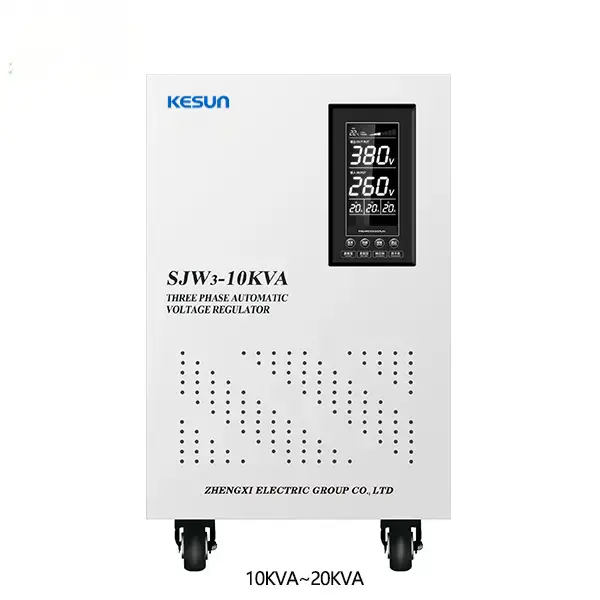
A servo voltage stabilizer is an automatic voltage regulation device that uses a servo motor, variable transformer, and control circuit to adjust voltage levels.
When the input voltage changes, the control system detects the fluctuation and moves the servo motor’s carbon brush on the variable transformer. This adjustment increases or decreases the output voltage, maintaining a stable power supply.
Advantages of Servo Voltage Stabilizer
- Wide input voltage correction range
- Stable and reliable voltage output
- Suitable for high-power applications
- Cost-effective compared with electronic solutions
- Long service life when properly maintained
Servo voltage stabilizers are widely used in industrial environments where voltage fluctuations are common.
Typical Applications:
- CNC machines
- Manufacturing equipment
- Medical devices
- Textile machinery
- Printing equipment
- Industrial automation systems
For factories that require continuous operation and stable voltage protection, a servo voltage stabilizer is a practical choice.
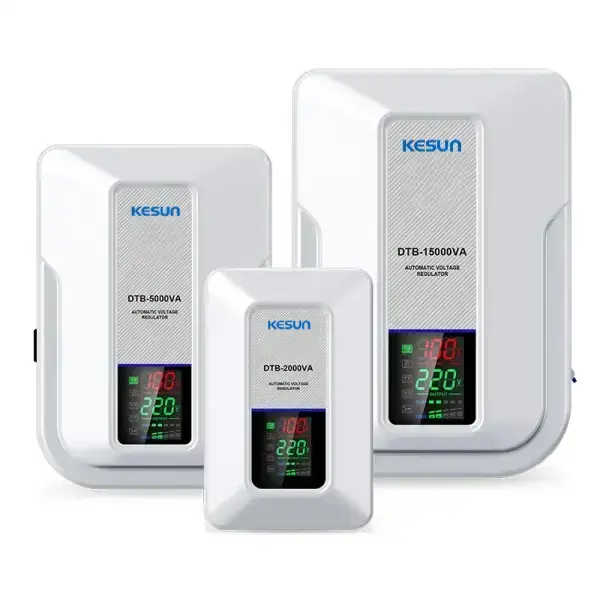
What Is a Static Voltage Stabilizer?
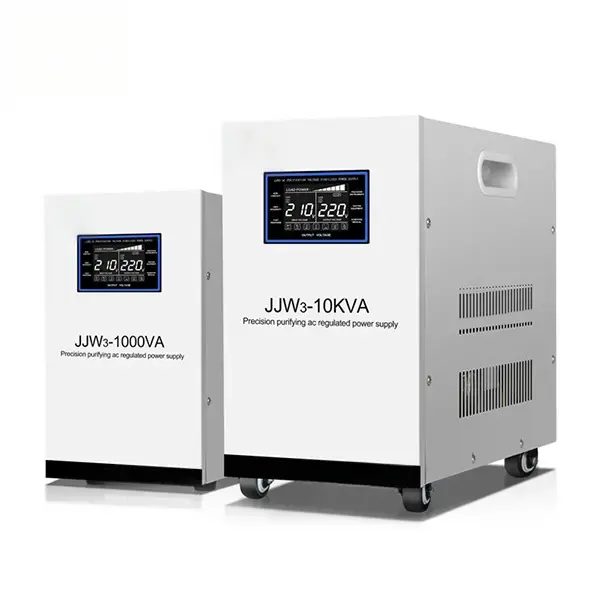
A static voltage stabilizer is an advanced voltage regulation device that uses power electronic components such as IGBTs, SCRs, and microprocessor control technology.
Unlike servo stabilizers, static stabilizers do not use mechanical moving parts. Voltage correction is performed electronically, allowing faster response and higher accuracy.
Advantages of Static Voltage Stabilizer
- Extremely fast voltage correction
- High output voltage accuracy
- No mechanical wear
- Low maintenance requirements
- Suitable for precision equipment
Static voltage stabilizers are commonly used in industries where even a short voltage variation may affect production quality or equipment performance.
Typical Applications:
- Data centers
- Semiconductor manufacturing
- Laboratory equipment
- Precision testing systems
- Communication equipment
- High-end automation systems

Servo vs Static Voltage Stabilizer Comparison
| Feature | Estabilizador de voltaje servo | Estabilizador de voltaje estático |
|---|---|---|
| Working Principle | Servo motor adjustment | Electronic power control |
| Adjustment Method | Mechanical movement | Semiconductor switching |
| Response Speed | Seconds level | Milliseconds level |
| Voltage Accuracy | Usually ±1% to ±3% | Up to ±0.5% |
| Mantenimiento | Requires regular inspection | Low maintenance |
| Costo | More economical | Higher initial cost |
| Power Range | Medium and high power applications | Precision and sensitive loads |
| Best Application | Industrial machines | Electronic and precision equipment |

Servo vs Static Stabilizer: Which One Is Better?
The answer depends on your application requirements.
A servo voltage stabilizer is recommended when:
- The power supply has large voltage fluctuations
- The equipment requires stable voltage but not ultra-fast correction
- You need an economical industrial solution
- The connected load is large
A static voltage stabilizer is better when:
- Fast response is critical
- Equipment requires high voltage accuracy
- You operate sensitive electronic systems
- Reducing maintenance is important
For example, a factory with motors, compressors, and production machines may benefit from a servo stabilizer. However, a semiconductor factory or data center may require a static stabilizer because of its faster response and higher precision.
Static vs Servo Voltage Stabilizer: How to Choose?
When comparing static vs servo voltage stabilizers, consider the following factors:
1. Voltage Fluctuation Range
If your area experiences large voltage variations, a servo voltage stabilizer with a wide correction range may be more suitable.
2. Equipment Sensitivity
Sensitive electronic equipment requires faster voltage regulation, making static voltage stabilizers a better option.
3. Operating Cost
Servo stabilizers usually have a lower purchase cost, while static stabilizers provide advantages in maintenance and long-term reliability.
4. Power Capacity
For large industrial loads, servo stabilizers are commonly selected. For precision applications, static technology provides better performance.
Conclusion
Both servo and static voltage stabilizers are reliable solutions for protecting electrical equipment from unstable voltage conditions.
A servo voltage stabilizer is ideal for industrial applications requiring stable voltage control, high capacity, and cost efficiency. A static voltage stabilizer is the preferred choice for precision equipment that requires fast response and higher voltage accuracy.
Before selecting a voltage stabilizer, consider your equipment type, voltage fluctuation level, power capacity, and accuracy requirements.
KESUNME provides professional voltage stabilization solutions, including servo voltage stabilizers and static voltage stabilizers for industrial, commercial, and specialized applications.
Bienvenido a nuestro Canal de YouTube for a deep tour. If you want to come for a visit, please feel free to contact us.