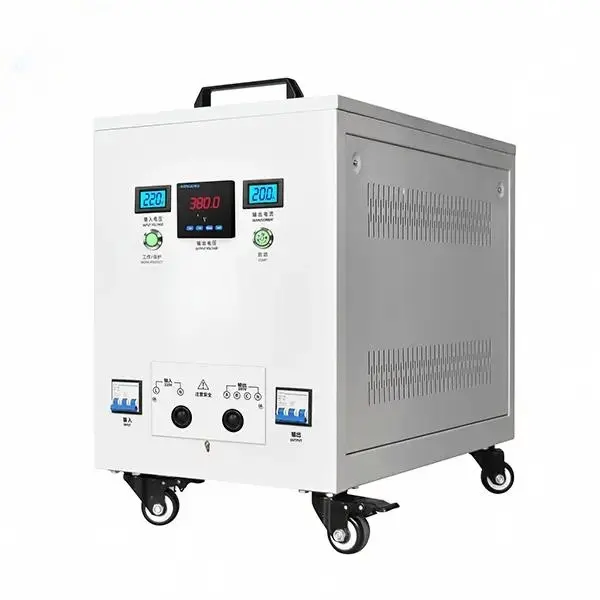
Choosing between a single phase vs three phase voltage stabilizer depends on your power supply, equipment requirements, and application. In this guide, we explain their key differences, common applications, benefits, and how to choose the right voltage stabilizer for residential, commercial, and industrial use.
Qu’est-ce qu’un stabilisateur de tension à phase unique ?
A stabilisateur de tension à phase unique is an electrical device that maintains a stable output voltage in single-phase power systems. It automatically adjusts voltage fluctuations to help protect connected equipment and support reliable operation.
Voltage instability can be caused by overloaded power grids, changing electricity demand, or unstable local power supplies. A voltage stabilizer regulates output voltage within its specified range, reducing the impact of abnormal voltage on electrical equipment.
Common Applications of Single-Phase Voltage Stabilizers
Single-phase voltage stabilizers are widely used in residential and small commercial environments, including:
- Home appliances: Refrigerators, washing machines, and televisions.
- Air conditioners: Help maintain a suitable supply voltage during fluctuations.
- Office equipment: Computers, printers, and other electronic devices.
- Refrigeration systems: Suitable for compatible refrigeration equipment in shops and small businesses.
- Small machines: Certain workshop machines and electrical tools.
Advantages of Single-Phase Voltage Stabilizers
- Voltage Regulation: Helps maintain a stable output voltage within the rated correction range.
- Equipment Protection: Reduces the effects of voltage fluctuations on connected devices.
- Reliable Operation: Supports consistent performance in areas with unstable power supplies.
- Flexible Installation: Available in different capacities for homes, offices, shops, and workshops.
How to Choose a Single-Phase Voltage Stabilizer
Consider the equipment’s rated power, input voltage range, required output voltage, and starting current. Appliances with motors or compressors may require additional capacity during startup.
A single-phase stabilizer is generally suitable when both the power supply and connected equipment use single-phase electricity.
Qu’est-ce qu’un stabilisateur de tension à trois phases ?
A stabilisateur de tension triphasé is designed to regulate voltage in three-phase electrical systems. It is commonly used in industrial facilities and commercial buildings where machinery requires a higher power capacity and a stable electrical supply.
By correcting voltage variations within its rated operating range, a three-phase stabilizer helps support the reliable operation of compatible industrial equipment.
Common Applications of Three-Phase Voltage Stabilizers
Three-phase voltage stabilizers are commonly used for:
- CNC machines: Support the power requirements of precision manufacturing equipment.
- Production lines: Helps maintain suitable voltage for manufacturing systems.
- Industrial motors: Used with compatible motors, pumps, and compressors.
- Elevators: Suitable for systems that meet the stabilizer’s electrical specifications.
- Medical equipment: Suitable for compatible equipment that requires regulated voltage.
- Factory machinery: Supports packaging machines, processing equipment, and other industrial loads.
Advantages of Three-Phase Voltage Stabilizers
- High-Power Capacity: Suitable for larger electrical loads and industrial applications.
- Stable Voltage Output: Helps regulate voltage for compatible three-phase equipment.
- Industrial Reliability: Can reduce voltage-related operating problems when correctly specified.
- Flexible Configurations: Available with different capacities, voltage ranges, and protection functions.
How to Choose a Three-Phase Voltage Stabilizer
Before purchasing, evaluate the total load, input and output voltage, frequency, motor starting current, and phase imbalance requirements. The stabilizer must match the connected equipment’s electrical specifications.
For factories and commercial facilities with three-phase power systems, selecting the correct stabilizer capacity and configuration is essential for reliable operation.
Single-Phase vs. Three-Phase Voltage Stabilizer: Which Is Better?
The right choice depends on your power supply and equipment requirements.
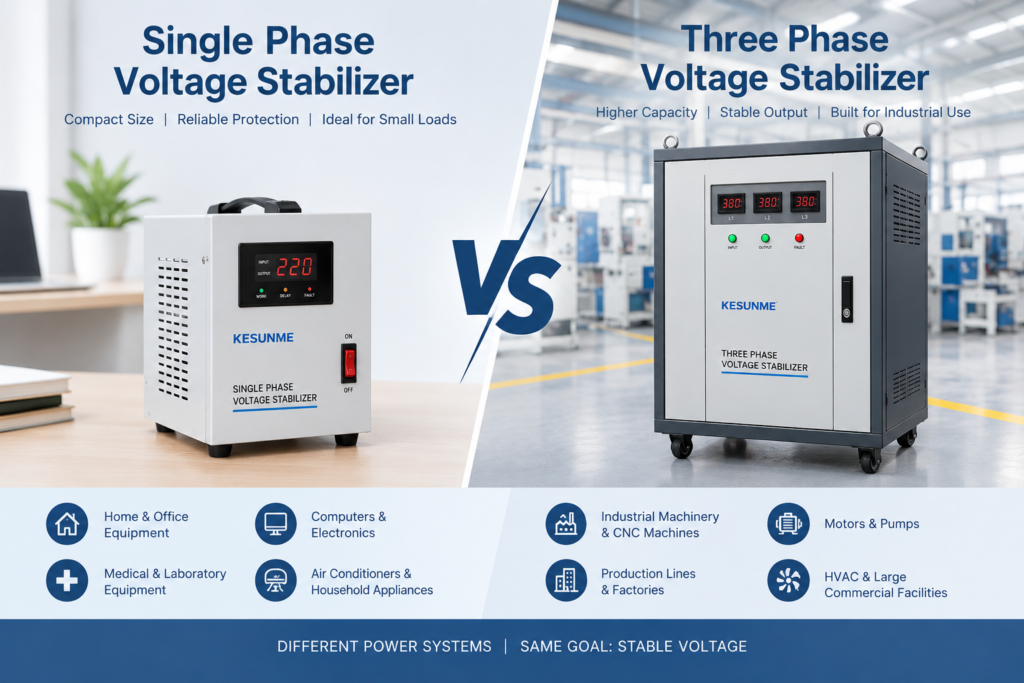
A stabilisateur de tension à phase unique generally suits household appliances, office equipment, and smaller electrical loads. A stabilisateur de tension triphasé is designed for industrial machinery, large motors, and higher-power commercial applications.
Before deciding, consider the load capacity, voltage fluctuation range, starting current, and operating environment. Choosing the right voltage stabilizer helps improve power stability and supports the long-term performance of your electrical equipment.
As a professional voltage stabilizer manufacturer, KESUNME provides voltage regulation solutions for different applications and power requirements.s.
Stabilisateur de tension à phase unique vs stabilisateur à trois phases
| Caractéristiques | Stabilisateur de tension à phase unique | Stabilisateur de tension triphasé |
|---|---|---|
| Système électrique | Phase unique | Trois phases |
| Applications typiques | Pour la maison et le bureau | Usine et industrie |
| Capacité de charge | Petite à moyenne | Moyen à élevé |
| Equipement courant | Appareils électroménagers, climatisation, ordinateurs | CNC, moteurs, machines |
| Installation | Plus simple | Plus complexe |
| Le meilleur pour | Applications résidentielles | Applications industrielles |
Conclusion
La principale différence entre un stabilisateur de tension à phase unique et un stabilisateur de tension triphasé est le type de système électrique pour lequel ils sont conçus.
Pour les maisons et les petits appareils, un modèle à phase unique est généralement adapté. Pour les usines, les machines CNC, les moteurs et d'autres équipements à haute puissance, un stabilisateur à trois phases constitue généralement le meilleur choix.
Choosing the right voltage stabilizer helps maintain stable power and improve the reliability of your electrical equipment.
Questions fréquemment posées
Quelle est la différence entre les stabilisateurs de tension à phase unique et à phase triphasée ?
Un stabilisateur à phase unique est conçu pour les systèmes d'alimentation à phase unique, tandis qu'un stabilisateur à trois phases est conçu pour les systèmes électriques à trois phases.
Quel stabilisateur de tension est le meilleur pour une usine ?
A stabilisateur de tension triphasé Il convient généralement mieux aux usines dotées de machines à trois phases et ayant de fortes charges électriques.
Can you use a single-phase voltage stabilizer for industrial equipment?
Oui, si l’équipement utilise une alimentation à phase unique et que le stabilisateur dispose d’une capacité suffisante. Vérifiez toujours les caractéristiques électriques de l’équipement avant de choisir un stabilisateur.
KESUN Fournit des stabilisateurs de tension à phase unique et à phase triphasée pour les applications commerciales et industrielles. Contactez-nous pour obtenir une solution de stabilisation de tension adaptée à votre projet.
Email:mark@kesunme.com
WhatsApp : +8617561692604