
Introduction: Servo Voltage Stabilizer vs Static Voltage Stabilizer
Choosing the right voltage regulation equipment is essential for industrial facilities where unstable power supplies can affect production efficiency, equipment performance, and operating costs.
Two common technologies are servo voltage stabilizers and static voltage stabilizers. Although both are designed to maintain a stable output voltage, they use different control technologies and have different advantages.
Understanding the differences between a servo voltage stabilizer vs static voltage stabilizer helps industrial buyers select the right solution for CNC machines, manufacturing equipment, automated production lines, and other sensitive electrical loads.
This guide compares their working principles, response speed, voltage accuracy, maintenance requirements, and practical industrial applications.
1. How Does a Servo Voltage Stabilizer Work?
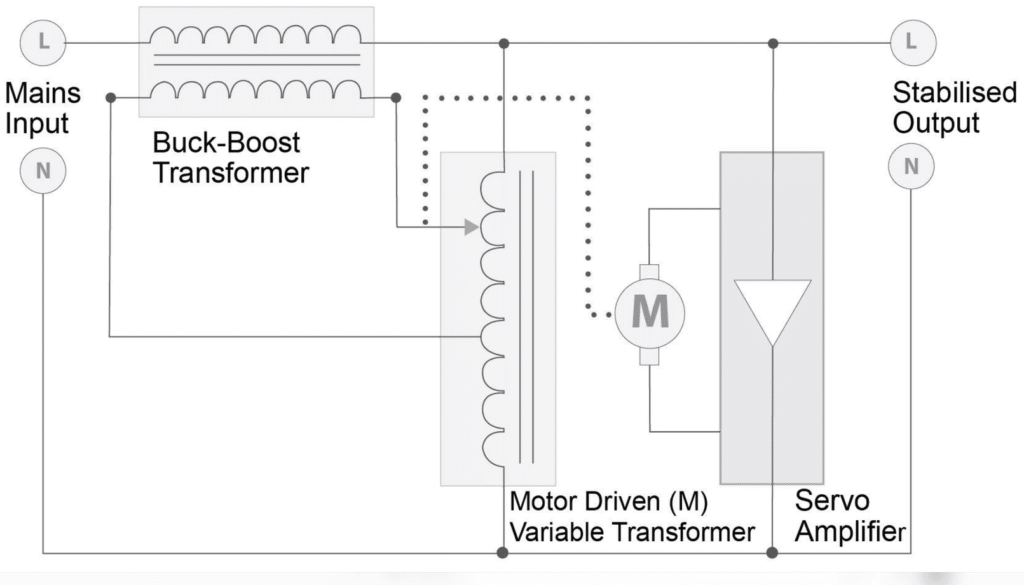
A servo voltage stabilizer uses an electromechanical voltage correction system to regulate output voltage automatically.
Its main components typically include:
- Motor Servo
- Variable autotransformer (Variac)
- Carbon brush assembly
- Buck-boost transformer
- Voltage sensing and control circuit
When the input voltage fluctuates, the sensing circuit detects the deviation and sends information to the controller. The controller activates the servo motor, which moves the carbon brush across the autotransformer winding.
This changes the correction voltage supplied through the buck-boost transformer, helping maintain the required output voltage.
Servo voltage stabilizers are widely used in industrial environments because they can provide accurate voltage regulation and accommodate different input voltage conditions, depending on the model.
Typical applications include CNC machinery, industrial motors, production equipment, and manufacturing facilities.
2. How Does a Static Voltage Stabilizer Work?
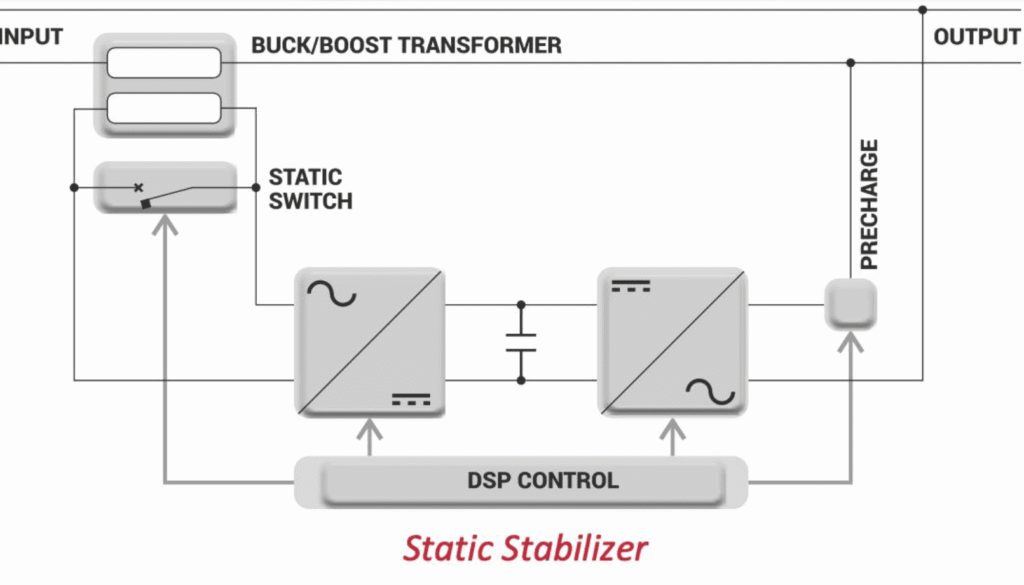
A static voltage stabilizer uses electronic control and power switching technology instead of a mechanically moving carbon brush assembly.
Its voltage sensing circuit continuously monitors the incoming supply. A digital controller processes voltage deviations and controls the electronic correction stage to maintain the desired output.
Depending on the design, static stabilizers may use semiconductor switching devices, power converters, and transformer-based correction circuits.
The absence of a mechanical brush adjustment mechanism provides an important advantage: voltage correction can be performed without waiting for a motor-driven mechanism to move.
This makes static voltage stabilizers particularly suitable for applications requiring rapid voltage correction.
Typical applications include sensitive electronic equipment, automated production systems, precision manufacturing, and facilities experiencing frequent voltage fluctuations.
However, the actual circuit topology, response time, and regulation accuracy must always be confirmed from the manufacturer’s technical specifications.
3. Servo Voltage Stabilizer vs Static Voltage Stabilizer: Key Differences
Both technologies regulate voltage, but their operating mechanisms create different performance characteristics.
| Comparison | Servo Stabilizer | Static Stabilizer |
|---|---|---|
| Regulation method | Electromechanical | Electronic |
| Moving components | Servo motor and carbon brush | No mechanical brush adjustment |
| Kecepatan respons | Generally slower | Generally faster |
| Voltage accuracy | Model dependent | Model dependent |
| Pemeliharaan | Brush and mechanical inspection | Electronic and cooling system inspection |
| Heavy industrial loads | Suitable with correct sizing | Suitable with correct sizing |
| Initial investment | Often more economical | Often higher |
Response speed: Static stabilizers generally respond faster because they use electronic switching rather than mechanical movement. This matters for equipment exposed to frequent, rapid voltage changes.
Maintenance: Servo stabilizers require periodic inspection of carbon brushes, contact surfaces, and moving components. Static stabilizers eliminate these mechanical wear points, although electronic components, cooling fans, and ventilation systems still require maintenance.
Voltage accuracy: Neither technology should be assumed to be more accurate in every situation. Buyers should compare the specified output voltage tolerance, operating range, and performance under different load conditions.
When comparing a servo voltage stabilizer vs static voltage stabilizer, industrial buyers should evaluate load characteristics, voltage fluctuation levels, correction speed, and long-term operating costs before making a purchasing decision.
4. Which Stabilizer Is Better for Industrial Applications?
The best choice depends on the operating environment and the electrical characteristics of the connected equipment.
Servo voltage stabilizers are suitable for:
- General manufacturing facilities
- Industrial motors and machinery
- CNC equipment with compatible power requirements
- Production lines requiring stable voltage
- Projects where equipment capacity and purchasing cost are important
Static voltage stabilizers are suitable for:
- Precision electronic manufacturing
- Automated production systems
- Sensitive electrical equipment
- Applications requiring rapid voltage correction
- Facilities where mechanical wear components should be minimized
For example, a factory operating several conventional industrial machines may find a servo stabilizer to be a practical and economical solution.
However, a production line with frequent voltage fluctuations and sensitive electronic control systems may benefit from a static stabilizer, provided its specifications match the actual load requirements.
Importantly, a voltage stabilizer cannot replace a UPS when uninterrupted power during a complete power failure is required.
5. How to Select the Right Capacity for Your Industrial Equipment
Selecting the correct capacity is just as important as choosing the stabilization technology.
A basic preliminary sizing formula is:
Required Stabilizer Capacity (kVA) = Total Load Power (kW) ÷ Power Factor × Safety Factor
For example, assume an industrial production line has:
- Total operating load: 45 kW
- Power factor: 0.90
- Illustrative safety factor: 1.25
Calculation:
45 ÷ 0.90 × 1.25 = 62.5 kVA
A 75 kVA stabilizer may be a reasonable preliminary selection, subject to verification of actual demand, starting current, load characteristics, input voltage range, and future expansion.
For large industrial motors, compressors, and CNC equipment, consider starting currents and nonlinear loads.
Before ordering, buyers should confirm:
- Rated input and output voltage.
- Single-phase or three-phase configuration.
- Minimum and maximum input voltage.
- Required output voltage accuracy.
- Total connected load and power factor.
- Motor starting current and load characteristics.
For additional industrial power solutions, explore KESUN’s three-phase voltage stabilizer solutions and static voltage stabilizer products.
6. Frequently Asked Questions
Q1: Is a static voltage stabilizer better than a servo voltage stabilizer?
Not necessarily. Static stabilizers generally provide faster electronic correction, while servo stabilizers offer an established electromechanical solution for many industrial applications. The best option depends on load characteristics, voltage fluctuations, required accuracy, and budget.
Q2: Which voltage stabilizer requires less maintenance?
Static stabilizers generally require less mechanical maintenance because they do not use motor-driven carbon brushes. However, their electronic components and cooling systems still require regular inspection.
Q3: Can a servo voltage stabilizer be used for CNC machines?
Yes. Servo stabilizers can be used with compatible CNC equipment when their voltage regulation accuracy, capacity, response characteristics, and protection functions meet the machine manufacturer’s requirements.
Q4: Can a static voltage stabilizer protect equipment against power outages?
No. A voltage stabilizer regulates voltage but does not independently provide backup power during a complete electricity interruption. An appropriately sized UPS or backup power system is required for uninterrupted operation.
Conclusion: Choose the Right Voltage Stabilizer for Your Factory
When comparing a servo voltage stabilizer vs static voltage stabilizer, buyers should consider more than the initial purchase price.
Servo stabilizers provide a practical solution for many industrial applications, while static stabilizers offer faster electronic correction and eliminate mechanical brush adjustment.
The correct choice depends on operating conditions, load capacity, voltage fluctuation characteristics, required accuracy, and long-term maintenance expectations.
KESUN provides industrial voltage stabilizers, automatic voltage regulators, and customized power solutions for international customers. Whether you need a servo voltage stabilizer or a static voltage regulation solution, our team can help evaluate your project requirements.
Contact KESUN today to discuss your application and request a customized quotation.
External Technical References
IEC – IEC 61000-4-11:2020: Voltage Dips, Short Interruptions and Voltage Variations